
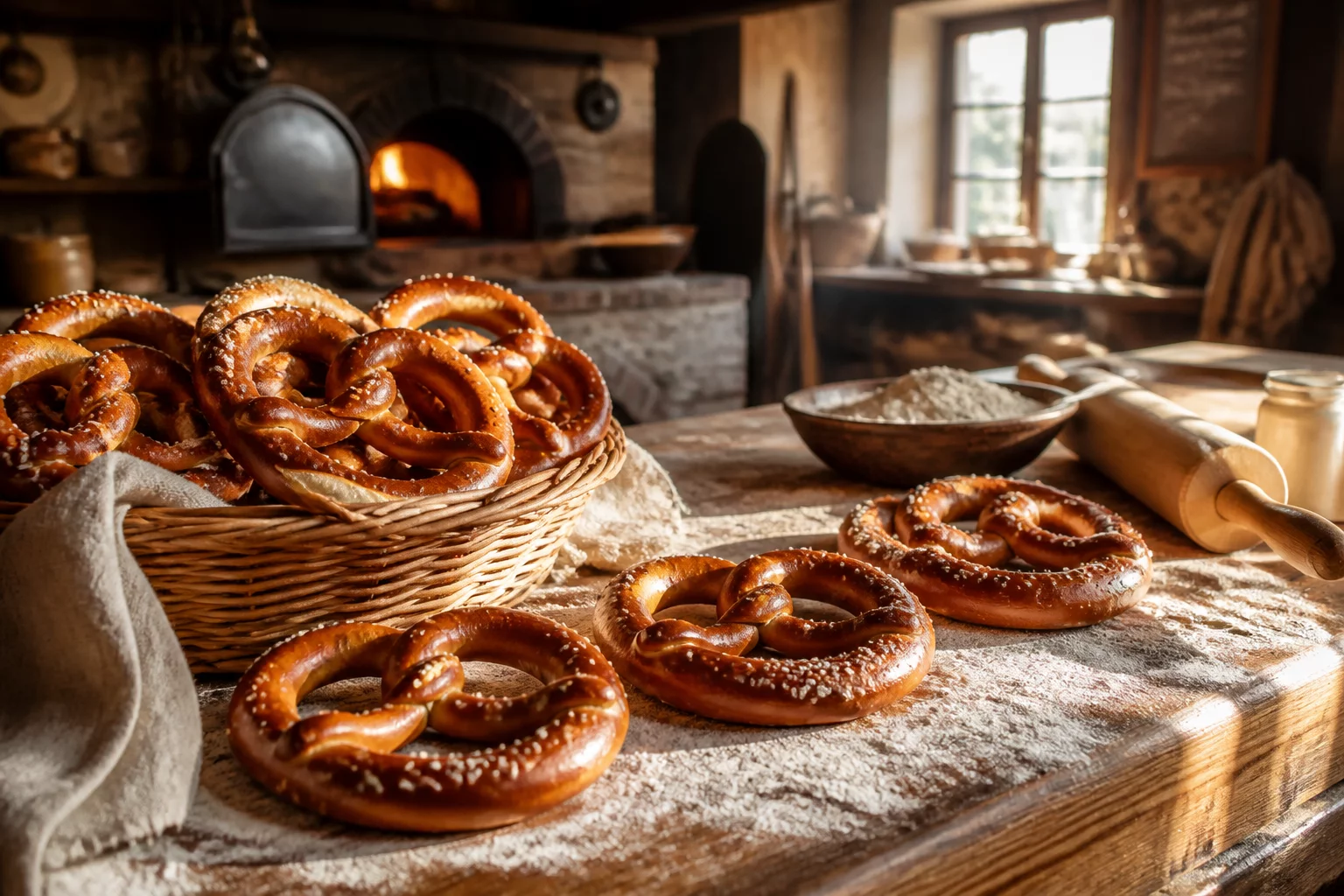
Few baked goods boast a heritage as deep and culturally rich as the pretzel. Before it became an essential fixture at sporting events, family gatherings, or craft breweries, this knotted loaf was a revered symbol of spiritual reward, architectural guilds, and community sustenance across medieval Europe.
The Monastic Origins: Arms Crossed in Prayer
Popular culinary folklore traces the earliest pretzel to around 610 AD in the monastery bakeries of Northern Italy or Southern France. Christian monks twisted surplus strips of unleavened dough into an iconic loop resembling crossed arms placed over the chest in prayer. These small baked dough rewards were originally called brachiola or pretiola, which translates directly to "little rewards."
Because the dough consisted solely of flour, water, and salt without prohibited dairy, lard, or eggs, pretzels quickly established themselves as the ideal food for Christian fasting periods such as Lent. The three distinctive openings in the finished knot also came to signify the Holy Trinity, cementing the food’s deep spiritual association throughout medieval Christendom.
The Bakers' Guild Emblem and Medieval Heroism
By the twelfth century, the pretzel had evolved into the official crest of German baking guilds. Historical records in Bavaria and Austria show intricate wrought-iron pretzel signs hanging above bakery entrances, a cherished visual tradition that endures across European villages to this day.
Pretzels even entered military history in 1510 during the Ottoman siege of Vienna. Monastic and guild bakers working underground in pre-dawn hours heard the subterranean digging of enemy sappers attempting to tunnel beneath city walls. The bakers sounded the alarm, alerting soldiers in time to repel the ambush. In royal gratitude, Emperor Maximilian I granted the bakeries an honorary coat of arms emblazoned with two lions holding a crowned pretzel.
Key Milestones in Pretzel Heritage
- 610 AD: Monks create pretiola dough knots as rewards for children memorizing prayers.
- 1111 AD: German baker guilds adopt the knotted pretzel as their official seal of master craftsmanship.
- 1839 AD: Bavarian master baker Anton Nepomuk Pfannenbrenner accidentally discovers the signature alkaline lye bath.
- 1861 AD: Julius Sturgis establishes the first commercial hard pretzel bakery in North America.
The Accidental Chemistry of the Alkaline Dip
The deep mahogany color, glossy crust, and distinct malty aroma of authentic pretzels come from a brief dip in an alkaline solution prior to baking. As Bavarian legend recounts, master baker Anton Pfannenbrenner of Munich mistakenly brushed his dough with a cleaning lye wash instead of sugar water in 1839. Terrified by the mistake, he baked the batch anyway, only to discover a lustrous deep golden crust and remarkable tenderness within.
This alkaline dip rapidly accelerates the Maillard browning reaction during high-heat baking, breaking down surface proteins into rich roasted notes and creating the distinct chewy outer shell that distinguishes true German-style pretzels from conventional breads.
The Journey Across the Atlantic to Canada
German and Swiss Palatine immigrants carried their cherished family starters and brass kettles across the Atlantic during the eighteenth and nineteenth centuries. While hard, shelf-stable snack pretzels rose to prominence throughout commercial distribution channels, traditional artisan kettle-boiled knots experienced a vibrant resurgence.
Today at Get Munches, we honor every step of this millennium-old lineage. We hand-twist each loop, employ slow fermentation for layered sourdough nuances, and kettle-finish our dough to deliver unmatched crunch, aroma, and taste across Canadian kitchens.
Written by Michael Baker
Artisan Bakery Specialist & Food Historian
Community Discussion
Alice
Verified ReaderFascinating history!
Leave a Reply
Share your thoughts with fellow pretzel enthusiasts.